Artificial intelligence (AI) has become one of the most talked-about technologies in business in recent years. Companies are implementing it into their processes to increase productivity, improve decision-making, or automate routine tasks. Despite large investments, however, many organizations are finding that technology alone is not enough.
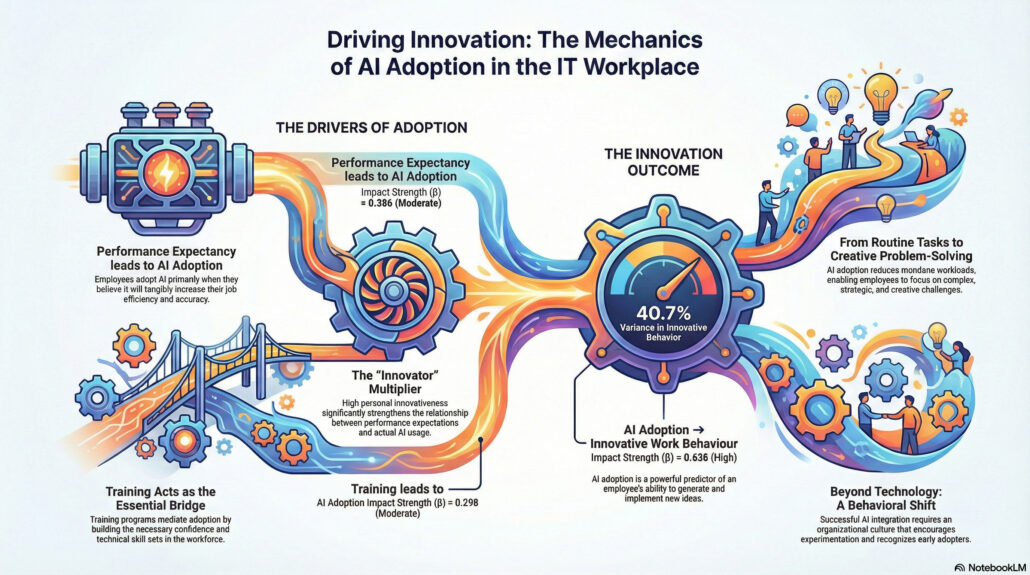
The real factor for success is people, their skills, motivation, and willingness to try new tools. Research on employees of IT companies shows that the adoption of artificial intelligence depends mainly on three factors: the expected benefits of the technology, quality training, and employees’ personal innovativeness.
Expected benefit
The most important factor is employees’ belief that AI will improve their work performance. If people believe that the technology will help them work faster, more accurately, or more efficiently, they are much more willing to use it. This phenomenon is well known from other technological innovations; we adopt new tools when we see their concrete value for our work.
Training and skills development
Another very important factor is education. The introduction of AI often also requires new skills. Employees need to understand how the technology works, what its capabilities are, and how to integrate it into their work.
Good training does more than just increase technical knowledge. It also helps reduce fears about new technology and build confidence in its use. Research shows that training significantly increases the likelihood that employees will actually start using AI.
Personal innovativeness
Not everyone reacts to new technologies the same way. Some are naturally curious and enjoy experimenting with new tools. Others are more cautious and need more time to get used to changes. Researchers refer to this trait as personal innovativeness, an individual’s willingness to try new technologies.
Employees with a high level of innovativeness are often the first to adopt AI and seek ways to integrate it into work processes. It is these “early adopters” who can play an important role within the organization, helping colleagues understand the technology’s benefits and motivating them to use it.
AI as a catalyst for creativity
One of the most interesting findings of the research is the relationship between AI use and innovative employee behavior. When people start actively using AI, they are more likely to come up with new ideas, experiment with different solutions, and look for more efficient ways of working. AI can support human thinking, for example, by providing rapid data analysis, generating solution suggestions, or helping to create new concepts.
Lesson for managers
There is one important lesson for companies: implementing artificial intelligence is not just a technology project, but above all an organizational change project. If organizations want to truly exploit the potential of AI, they must focus not only on the technology itself but also on developing people and corporate culture. The key is to invest in high-quality training and the systematic development of employee skills, support experimentation with new tools, and actively identify employees who are naturally open to innovation and can become change agents within the team. Equally important is creating an environment that supports learning, sharing experiences, and collaboration. If companies can connect these factors, artificial intelligence can become not only a tool for increasing efficiency but also a powerful engine for innovation. That is why in the future, the success of AI in companies will depend less on the algorithms themselves and more on a culture of learning, openness, and innovation.
Citation:
Vandana, V., Chatterjee, S., Rozsa, Z., & Ferraris, A. (2026). AI adoption drivers and innovative work behaviours. European Journal of Innovation Management, 1–20. https://doi.org/10.1108/EJIM-03-2025-0327